Continuous patient reassessment that operates between triage and provider evaluation. Voice-first. 50+ languages. FHIR-ready. Every meaningful change surfaced, every routine wait honored.
Sarah walked into the ED at 9:38 PM with chest tightness. Here's what happened in the four hours she waited — through Jessie's eyes.
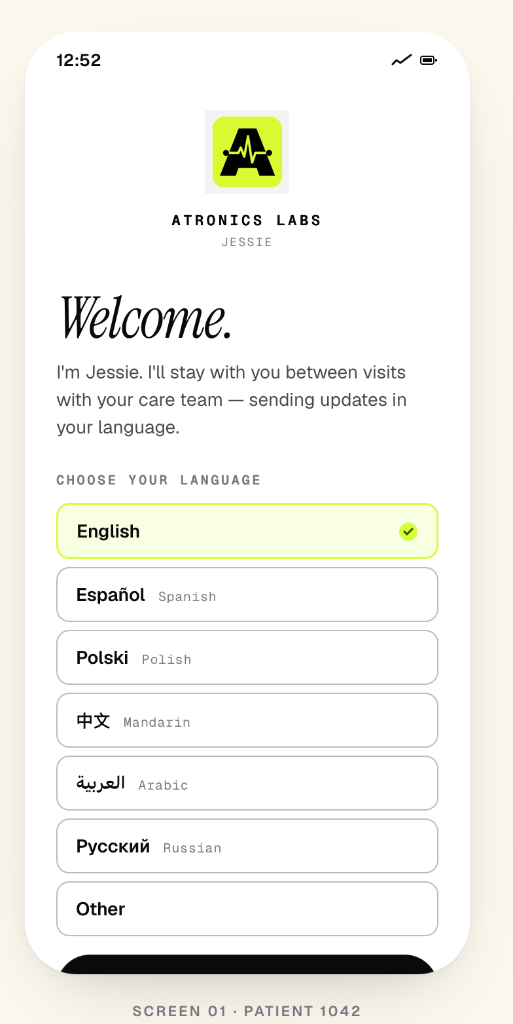
Sarah picks English on the kiosk. Jessie could have offered her Español, Polski, 中文, العربية, or 46 other native voices. The intake starts warm, not clinical.
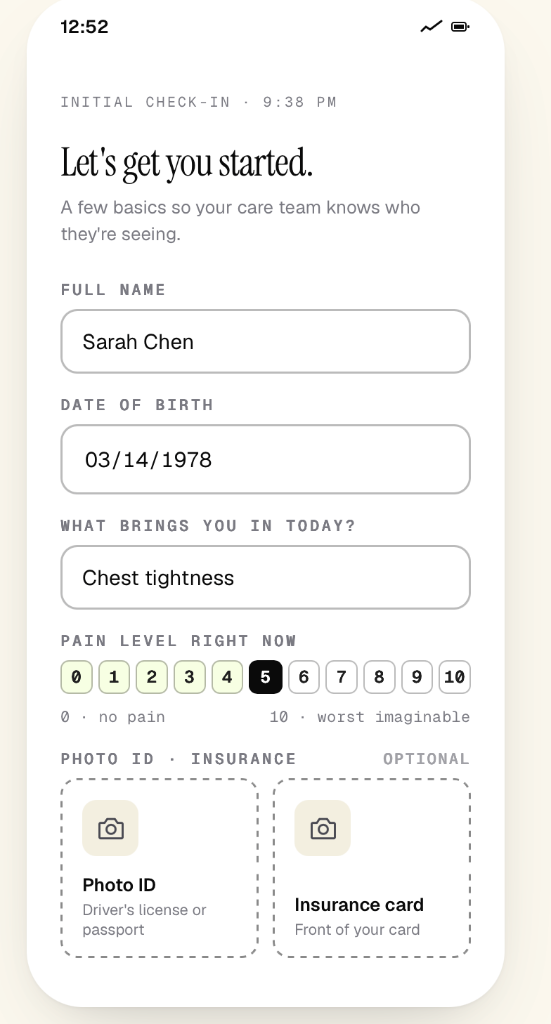
Name, DOB, chief complaint, pain level, ID and insurance. All captured before triage. Every field becomes structured, FHIR-aligned data — with the patient's exact words preserved.
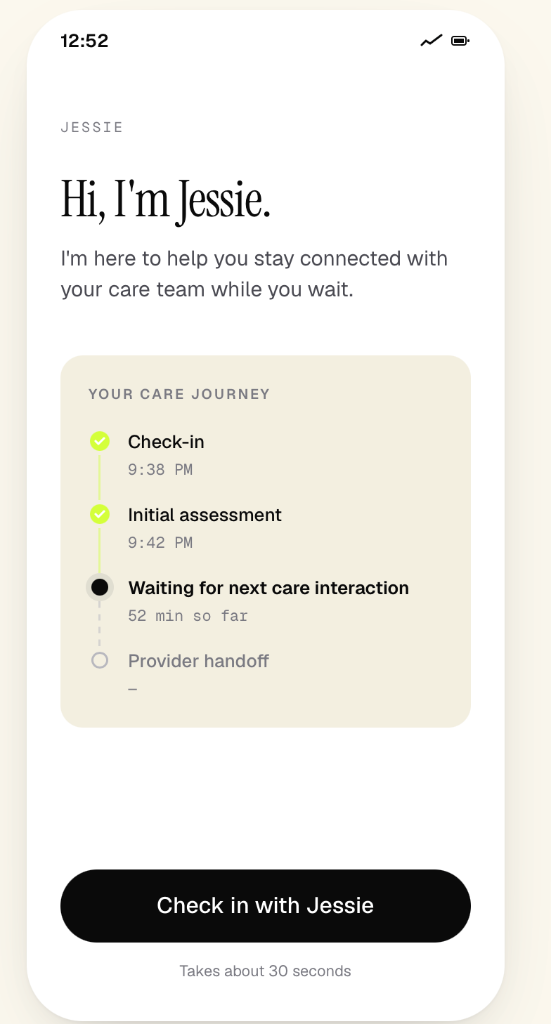
Between the initial assessment and the next care interaction, Jessie stays with her. She can check in — type, speak, or tap. Every check-in takes 30 seconds. Every one is compared against her baseline.
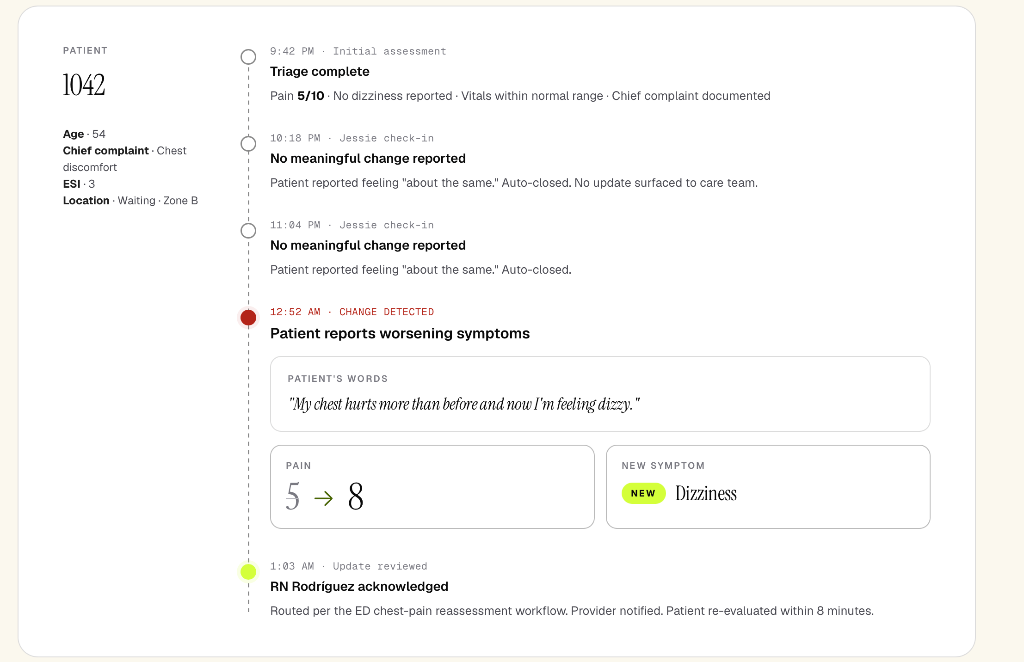
Sarah tells Jessie her chest hurts more and she's now feeling dizzy. Jessie recognizes the red-flag combination against her chest-pain baseline, escalates directly to a nurse instead of routing to In Basket, and gives Sarah a one-tap page.
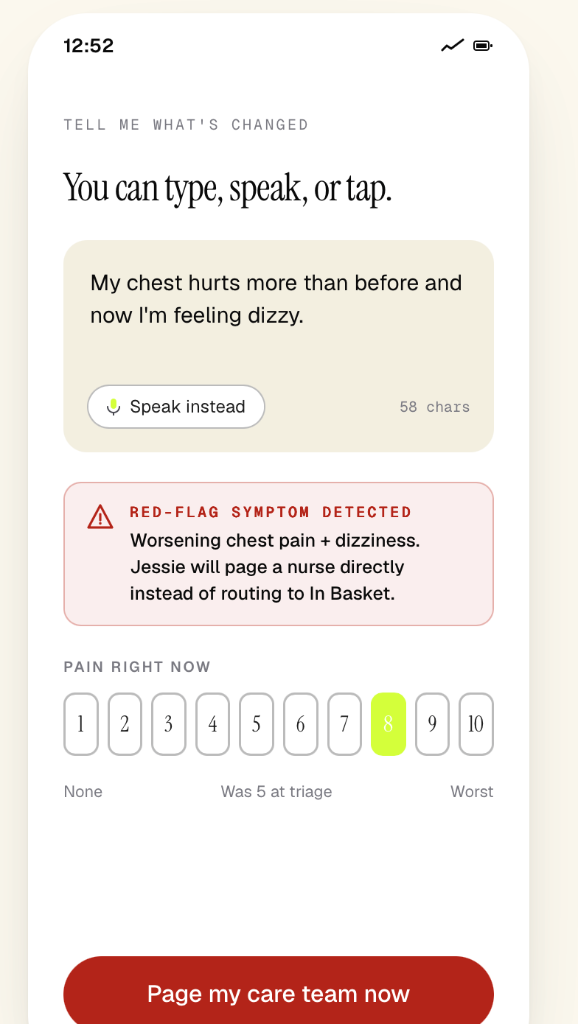
Nothing routed for the two check-ins where nothing changed. One clear alert for the moment that mattered. Full audit trail. RN acknowledgment. Every quote preserved for the chart.
Two check-ins were logged and auto-closed without paging anyone. No alarm fatigue.
Patient's own words become the trigger: “chest hurts more” + “dizzy” in a chest-pain baseline.
RN Rodríguez acknowledged, provider was notified, patient re-evaluated within 8 minutes. Every decision, a person.
A useful reassessment layer has to do six things well at once. Miss any one and it becomes noise — or worse.
Every follow-up is grounded in what the patient told triage. "Worse" means nothing without a baseline to be worse than.
Score, quality, location, symptom count, and intent — tracked as a delta, not a snapshot.
Patient language becomes clinical data — with the raw quote preserved for the chart.
Escalation thresholds, timers, and routing are configured with your team. Nothing hard-coded.
Only meaningful changes surface. Nobody adds a new alarm to a nursing station casually.
Charge nurse, house supervisor, provider — different signals, different owners.
Edge-first. Interoperability-first. Safety-first. Every architectural choice starts with hospital IT review.
PHI never leaves the network unless you opt in. Sub-second latency, even in the basement.
Structured JSON · FHIR-aligned summaries · Epic and Cerner integration scoped during pilot planning.
Message bridges for downstream systems that don't speak FHIR yet.
BAA-ready. Audit trail on every interaction. Security review support in every pilot.